


By J. H. Irwin
Author | Storyteller | Capturing Life, Memory, and Meaning
RuPaul built a life around visibility, transformation, and the audacity to be seen. Georges LeBar chose distance from celebrity, trading red carpets for painting, ranchland, and a private life far from Hollywood. They met on a New York dance floor in 1994, when their love had no legal recognition, and discovered that devotion did not require two people to live the same life. More than three decades later, theirs is a story about trust, recovery, freedom, and the quiet person behind one of the loudest and most consequential careers in LGBTQ+ culture.
On January 24, 1994, RuPaul walked into the Limelight in New York City and saw someone rising above the crowd. Georges LeBar, an Australian art student celebrating his twenty-first birthday, was dancing wildly in platform shoes. Even RuPaul, six feet four inches without heels and accustomed to commanding every room he entered, was intrigued by a man taller than himself.
RuPaul crossed the dance floor and introduced himself. The encounter had the spontaneity of a nightclub story, but it became the beginning of a relationship that would survive fame, addiction, separation, recovery, distance, and a changing definition of marriage in America.
The timing mattered. RuPaul had recently broken through with “Supermodel (You Better Work),” the 1992 dance single that carried a Black gay drag performer from the clubs into MTV, radio, and popular culture. He was becoming famous at a moment when queer visibility could still attract ridicule, censorship, or violence, and when the AIDS crisis remained a source of grief and fear throughout the community.
Georges entered that world without wanting to become part of its machinery. He was interested in art, fashion, and eventually the vast Wyoming ranch connected to his American family. RuPaul wanted the stage, while Georges wanted a life that could remain largely his own.
Their differences might have made the relationship impossible. Instead, they became part of its design.
A Love Without Legal Recognition
When RuPaul and Georges met, no state in the country issued marriage licenses to same-sex couples. Their relationship could become emotionally permanent, but the law offered them none of the automatic protections that heterosexual spouses took for granted.
The Defense of Marriage Act would be signed two years later, defining marriage for federal purposes as the union of one man and one woman. Its language told couples like RuPaul and Georges that no matter how many years they shared, the federal government would treat them as legal strangers.
That exclusion affected far more than ceremonies. Marriage governed inheritance, taxes, hospital access, property, health benefits, and the authority to make decisions during illness or death. The AIDS crisis had already shown LGBTQ+ people the human cost of being denied those rights, as partners were shut out of hospital rooms, funerals, homes, and estates by relatives or institutions that refused to recognize them as family.
RuPaul and Georges therefore began their life together in a familiar contradiction. Their love was real, but the world around them reserved the word marriage for other people.
They did not respond by trying to imitate a conventional couple. They built a relationship suited to who they actually were, even when that life made little sense to outsiders.
The Superstar and the Man Who Did Not Care About Stardom
RuPaul’s career accelerated quickly after their meeting. He became the first drag performer associated with the MAC Viva Glam campaign, hosted The RuPaul Show on VH1, recorded music, appeared in films, and developed a public identity built upon glamour, humor, and fearless self-invention.
The achievement was historic. RuPaul carried drag into mainstream spaces that had rarely permitted a Black queer performer to arrive with such control over his own image. Every appearance challenged the assumption that acceptance required becoming quieter, smaller, or less visibly different.
Georges did not compete with that public life. He painted, managed ranchland, and maintained a privacy so complete that he has rarely given interviews. The man married to one of the most recognizable LGBTQ+ figures in the world did not attempt to turn proximity into a second career.
RuPaul has often joked that Georges does not care about show business. Beneath the joke is one of the reasons their relationship endured. Georges knew the difference between the person and the performance, and RuPaul could return to someone who was not dazzled by the machinery surrounding him.
Fame can make intimacy difficult because it brings attention without necessarily bringing understanding. Georges offered the opposite: understanding without demanding attention.
A Safe Place for a Sensitive Heart
RuPaul’s public confidence was hard won. His childhood had taught him to watch people carefully, hide vulnerability, and use humor or performance to control how others saw him. An absent father and a volatile home left him suspicious of anyone who might be careless with his feelings. During the March 13, 2024 episode of Call Her Daddy, RuPaul explained what he recognized in Georges almost immediately:
“He has never hurt my feelings. Never.”
The brevity makes the statement more powerful. RuPaul does not praise Georges through grand romantic imagery, but through the absence of injury.
For someone who learned early that love could be unreliable, emotional safety was not a modest gift. It was the condition that made intimacy possible. Georges’s kindness allowed RuPaul to lower a guard that applause, fame, and professional achievement could never remove.
The repeated word never also reveals the extraordinary standard by which RuPaul measures their life together. It does not mean they have never disagreed or experienced pain. It means that, in RuPaul’s telling, Georges has never used the knowledge that comes with intimacy as a weapon.
Love is often described through what another person gives us. Sometimes its deepest meaning lies in what they refuse to do with the power we have entrusted to them.
When Love Could Not Protect Them From Themselves
The early years of their relationship unfolded amid intense work, travel, nightlife, and substance use. RuPaul’s success brought extraordinary opportunities, but it did not resolve the wounds or habits that existed beneath the public triumph.
By the end of the 1990s, Georges was struggling with crystal methamphetamine addiction. RuPaul saw him becoming thinner, sleeping for long periods, and behaving with an anger and distance he did not understand. When Georges finally admitted what was happening, RuPaul helped him enter treatment.
The crisis forced RuPaul to see something about himself. He had approached the problem as the healthier partner helping the person in danger, but at a recovery meeting he recognized his own emotional disconnection in the stories being told around him. Georges’s addiction had become a mirror in which RuPaul could finally see his dependence on marijuana, cocaine, and the constant search for escape. They separated so each could face himself without using the relationship as shelter from the truth.
Love could get Georges to treatment. It could not do the work of recovery for either man.
In the memoir excerpt published by Time on February 28, 2024, RuPaul described the decision plainly. His words make clear that the distance served a purpose:
“We separated … it was what we needed at the time, to grow as individuals.”
Separation is usually treated as evidence that love has failed. Here, it became evidence that love had stopped pretending it could substitute for healing.
The words what we needed contain both pain and discipline. RuPaul and Georges did not remain together at any cost, because staying close while each was unwell might have destroyed them both. They accepted distance as the price of becoming people capable of choosing one another again.
RuPaul entered therapy and attended twelve-step meetings, sometimes twice a day. He has said he has remained sober since 1999. Georges pursued his own recovery, and although the two men separated, they continued speaking every day.
Their relationship did not endure because crisis left it untouched. It endured because they allowed crisis to change it.
Finding Each Other Again
RuPaul and Georges eventually reunited. By then, their bond had moved beyond the exhilaration of the Limelight dance floor and into the more difficult territory of knowing what another person looks like when charm, success, and denial no longer provide cover.
Sobriety changed RuPaul’s understanding of ambition. He had spent much of his life seeking validation through fame, partly hoping the world could supply what his childhood had withheld. Recovery required him to discover a sense of worth that did not depend upon the next audience, opportunity, or achievement.
Georges remained connected to that transformation. The man RuPaul once described as his conduit to joy could no longer be responsible for carrying RuPaul into his own life. Their reunion therefore rested on something sturdier than rescue: two individuals choosing partnership after learning that neither could save the other.
This is one of the least glamorous parts of their love story, and one of the most meaningful. Endurance did not come from refusing to separate. It came from understanding why separation had become necessary and returning without erasing what it taught them.
Love Without Possession
RuPaul and Georges have also been open about rejecting monogamy as the measure of commitment. Their marriage allows each man freedom beyond the relationship, an arrangement RuPaul has described as grounded in mutual respect rather than secrecy.
That aspect of their life can become the detail outsiders focus upon, as if an unconventional structure makes devotion less serious. RuPaul’s own explanation points in the opposite direction. He trusts what exists between them enough not to confuse love with ownership.
Their arrangement depends upon boundaries, care, and an unwillingness to humiliate one another. The freedom they offer each other is not indifference. It is based on RuPaul’s certainty that Georges loves him and on the confidence that neither will turn that freedom into cruelty.
Their long periods apart follow the same principle. Georges has spent much of his time on the ranch in Wyoming, while RuPaul’s work has kept him in Los Angeles, New York, and production locations around the world. They have not required constant proximity to prove that the relationship is real.
Instead, they meet in the places where both can step away from work. RuPaul once summarized the arrangement as Georges working the ranch, RuPaul working Hollywood, and the two of them reuniting somewhere fabulous. The humor disguises a practical wisdom: lasting love sometimes depends upon allowing each person to inhabit the life that gives him purpose.
Devotion Before Marriage
By the time RuPaul’s Drag Race premiered in 2009, RuPaul and Georges had already been together for fifteen years. The program that initially appeared on the small LGBTQ+ network Logo would become a global cultural force, carrying the language, humor, artistry, and emotional lives of drag performers into homes far beyond the clubs that created them.
The show’s success made RuPaul more visible than ever, but Georges remained largely outside the frame. Their relationship was not a publicity instrument, and the lack of photographs or interviews did not indicate absence. Privacy was one of the ways they protected what belonged to them.
Legal recognition slowly caught up with the life they had already built. New York enacted marriage equality in 2011, and the United States Supreme Court extended the freedom to marry nationwide through Obergefell v. Hodges on June 26, 2015. By then, RuPaul and Georges had been devoted to one another for more than two decades.
They still did not rush to marry. RuPaul had never placed much faith in ceremony, and neither man needed a license to tell him whether the relationship was genuine. Their reluctance was not a rejection of marriage equality, but a distinction between emotional commitment and government recognition.
The 2016 presidential election altered their calculation. A right that had seemed secure suddenly felt politically vulnerable, and the legal protections attached to marriage became harder to dismiss. Their businesses, property, inheritance, and authority over the life they shared carried consequences that devotion alone could not settle.
On January 24, 2017, the twenty-third anniversary of their first meeting and Georges’s forty-fourth birthday, they married in a small ceremony at their Los Angeles-area home. Their wedding was private, and RuPaul did not announce it publicly until March.
The choice exposed one of marriage equality’s deepest meanings. The license did not create their family, but it compelled the law to recognize what had already survived for twenty-three years.
The Person Behind the Phenomenon
RuPaul’s influence continued expanding. Drag Race produced international editions, launched careers, won major awards, and introduced millions of viewers to LGBTQ+ lives through stories of rejection, chosen family, resilience, and self-acceptance.
Georges remained the person to whom RuPaul returned when the performance ended. In a 2018 interview, RuPaul became emotional while explaining that among the millions of people in the world, Georges was the one he liked most. The distinction between loving and liking matters, especially after decades together.
Love can be sustained by history, responsibility, or habit even when two people no longer enjoy one another. RuPaul’s description suggests something warmer. Georges is not merely the keeper of the past or the spouse recognized by law. He is still the person whose company RuPaul chooses.
That affection survives their different temperaments. RuPaul is a performer whose art depends upon spectacle, while Georges has resisted becoming a public personality. One thrives by commanding attention, and the other has built a life by declining it.
Their love did not erase those differences. It made room for them.
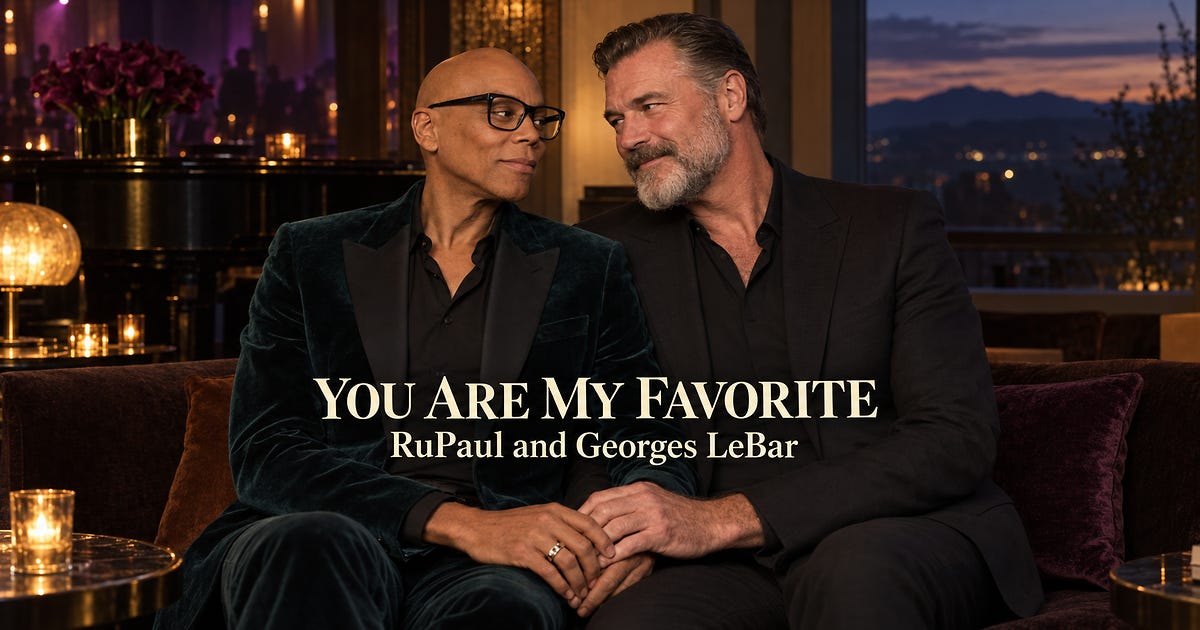
You Are My Favorite
In 2024, RuPaul published The House of Hidden Meanings, a memoir that looked behind the self-created mythology and examined the childhood, ambition, addiction, and relationships that shaped him. The book ended around the period when he and Georges entered recovery, but its dedication revealed where the story ultimately led. RuPaul addressed the book to Georges with these words:
“Thank you for the love, laughter, sweetness, and kindness. You are my favorite.”
After thirty years, RuPaul did not thank Georges for completing him. He thanked him for the daily qualities through which a life together is actually made.
Love appears beside laughter, because endurance without joy can become obligation. Sweetness and kindness follow, the very qualities RuPaul had once hoped to find in a partner and the qualities that made Georges feel safe to a man who had learned to protect his heart.
The final sentence is almost childlike in its directness. You are my favorite contains none of the elaborate language one might expect from a master of performance. Its intimacy comes from how little performance it needs.
Their Known Conclusion
As of September 2026, RuPaul and Georges LeBar remain married and have shared more than thirty-two years together. Their lives continue to move between the public world of television and the private worlds they maintain in California and Wyoming.
There is no final farewell to recount because their story is still being lived. The known conclusion is therefore not death, separation, or a box of letters opened after both men are gone. It is the quieter fact that they continue to choose one another.
Their relationship has already crossed several eras of American LGBTQ+ life. It began when the federal government would not recognize a same-sex marriage, survived the passage and eventual fall of the Defense of Marriage Act, and became a legal marriage only after nationwide equality had been won.
Yet law is only one part of what they endured. They survived the pressure of fame, the solitude created by distance, the vulnerability of recovery, and the difficult recognition that loving someone may require releasing him long enough for both people to heal.
Theirs is not a conventional marriage, but conventionality was never RuPaul’s measure of truth. The relationship works because it belongs to the two people living it rather than to the expectations of spectators.
Still In Love
RuPaul and Georges LeBar met beneath nightclub lights, surrounded by motion, music, and a queer culture that knew how to create joy in the shadow of grief. Nothing about that first night guaranteed permanence. One man was entering global fame, while the other would eventually choose a life defined by privacy and open land.
What held them together was not sameness. It was trust.
Georges gave RuPaul a place where sensitivity was not a weakness to exploit. RuPaul gave Georges the freedom to remain himself beside a public figure whose fame could easily have consumed both of them. When addiction threatened their lives, they separated rather than asking love to perform a cure it could not provide.
They returned as people who had begun learning how to care for themselves. The devotion they carried for twenty-three years before marriage proved that their bond did not depend upon legal validation, while their decision to marry acknowledged that love deserves protection as well as recognition.
RuPaul has spent a lifetime showing the world that identity can be expansive, playful, and self-created. His relationship with Georges carries the same wisdom. There is no single correct way for two people to build a faithful life, provided that freedom is joined by honesty and love is joined by care.
The man known for transformation found something constant. The performer surrounded by millions found the person he trusted with the feelings behind the performance.
After the music, the fame, the recovery meetings, the ranch roads, the television empire, and all the years spent moving between separate worlds, RuPaul’s most intimate declaration required only four words. Georges was still his favorite.
Source and excerpt credit
No private letters between RuPaul and Georges LeBar have been published, and no public archive or manuscript collection of their correspondence is known. This feature therefore does not present its excerpts as letters. It uses one written dedication addressed to Georges and two first-person statements by RuPaul that are preserved in authorized publications or recorded interviews.
The first excerpt, “He has never hurt my feelings. Never,” was spoken by RuPaul about Georges LeBar to interviewer Alex Cooper on the March 13, 2024 episode of Call Her Daddy, titled “RuPaul: Blocking Out the Bullshit.” Georges was the subject, not the direct recipient. The episode is preserved through the program’s official Spotify release and official YouTube presentation.
The second excerpt, “We separated … it was what we needed at the time, to grow as individuals,” was written by RuPaul about his separation from Georges LeBar. It appears in The House of Hidden Meanings and in the authorized excerpt “The Moment I Knew I Needed to Get Sober,” published by Time on February 28, 2024. The words are autobiographical narration rather than a letter to Georges. Readers can access the authorized excerpt through Time.
The third excerpt, “Thank you for the love, laughter, sweetness, and kindness. You are my favorite,” was written by RuPaul to Georges LeBar as the dedication to The House of Hidden Meanings: A Memoir. The dedication itself is undated, so March 5, 2024, the book’s publication date, is used as its documentary date. The collection is the memoir itself, written by RuPaul and published in New York by Dey Street Books, an imprint of HarperCollins. The publisher’s bibliographic record credits RuPaul as the sole author and does not name a separate editor. The New Yorker identifies writer Sam Lansky as having helped RuPaul with the memoir, but he is not presented in the publisher’s record as the book’s editor.
Readers can obtain the authorized edition through RuPaul’s official website or the HarperCollins publisher page. The hardcover edition carries ISBN 978-0-06-326390-1.
The original interview media function as the available public record for the spoken excerpts, while the published memoir is the authoritative source for the written dedication and recovery account. There is no known institutional archive holding RuPaul and Georges LeBar’s private papers, so no archive box, folder, manuscript number, or correspondence editor can responsibly be credited.
Additional factual context comes from the New York State account of marriage equality and Obergefell v. Hodges, the 2018 Guardian interview in which RuPaul discussed the structure of their relationship, the 2017 Vanity Fair report on their marriage, and People magazine’s profile of Georges LeBar and the couple’s history. The current-status statement was checked against the RuPaul biography updated in June 2026, which continues to identify Georges LeBar as his husband.
Words can still move the world. Read mine → https://substack.com/@jhirwin
The Still in Love Promise
Every story honors love. Every journey is told with honesty and heart. Every page celebrates the enduring power of love.