


By J. H. Irwin
Author | Storyteller | Capturing Life, Memory, and Meaning
Jake and Hannah Graf are one of Britain’s most visible transgender couples, whose marriage and family have helped challenge long-standing assumptions about transgender life and love. Jake is an award-winning filmmaker, actor, and writer, while Hannah is a former British Army captain who received an MBE for her work advancing LGBTQ+ inclusion within the Armed Forces. What makes their story especially remarkable is not simply that they are both transgender, but that each once believed transition might make lasting love and parenthood impossible. Together, they built the future they had struggled to imagine, becoming husband and wife, parents to two daughters, and powerful examples of the truth that transgender people share the same hopes for love, commitment, family, and belonging as anyone else.
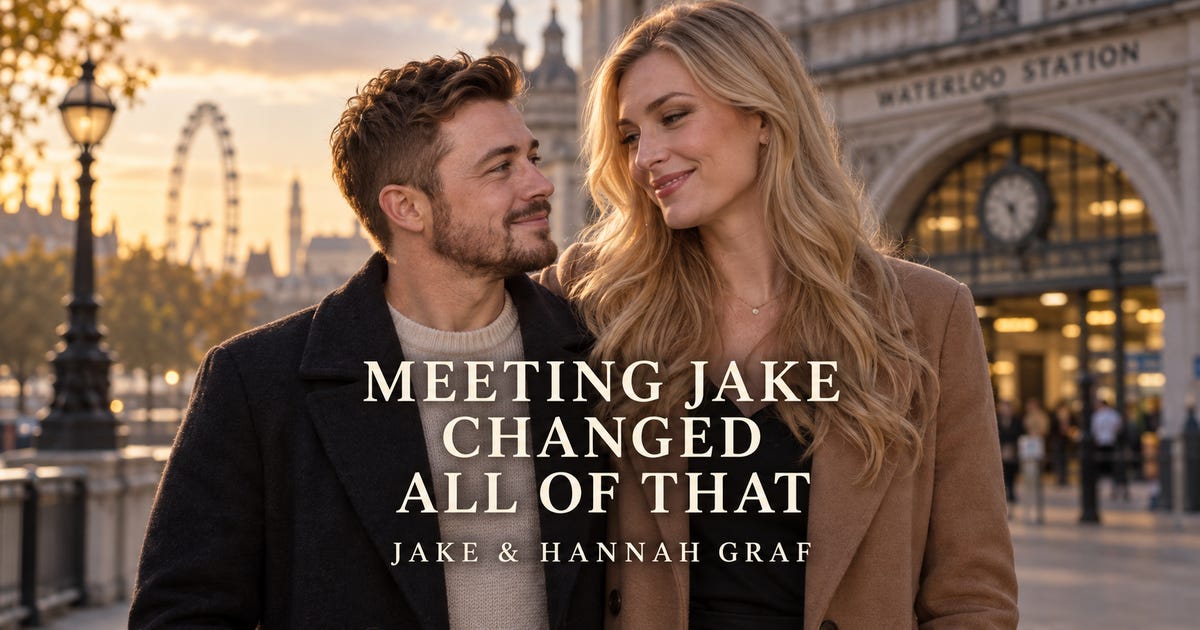
Jake Graf had spent years searching for the language, community, and creative purpose that would allow him to live as himself. Hannah Graf had commanded soldiers while privately believing that transition might cost her any chance of love. When they met beneath the clock at Waterloo Station in 2015, each encountered something the world had taught them not to expect: a future.
On December 30, 2015, Jake Graf arrived at London Waterloo to meet Hannah for the first time. He had noticed her in the news, found that they shared friends in the transgender community, and sent her a Facebook request. She accepted, suggested a drink, and soon moved the conversation from messages to a telephone call.
The date began beneath the station clock and continued along the Thames. They walked, ate dinner, shared drinks, and talked until two in the morning. For Jake, an actor and filmmaker who had already begun turning transgender lives into stories, attraction came immediately. For Hannah, a British Army captain who had never been on a date, the evening carried a more astonishing possibility.
They met in a Britain that had changed dramatically during their lifetimes. Same-sex relationships had gained legal recognition, transgender people were becoming more visible, and the Armed Forces had begun dismantling some of the exclusions that had once defined military life. Yet visibility did not mean safety. Trans people were still routinely treated by newspapers as revelations, spectacles, or arguments rather than as human beings.
Both Jake and Hannah had reached adulthood without seeing lives like theirs represented with tenderness. Each had once imagined that authenticity and lasting love might be mutually exclusive. Their first date mattered because it suggested the opposite.
Theirs would become a marriage, a family, a documentary, and a jointly written memoir. Before it became any of those things, it was simply an unexpectedly long evening between two people who had learned how dangerous hope could feel.
Children of Silence
Jake and Hannah grew up during an era when British institutions offered LGBTQ+ children little language with which to understand themselves. Section 28 of the Local Government Act 1988 prohibited local authorities from promoting homosexuality or presenting same-sex family relationships as acceptable. Although the law did not specifically address transgender identity, it helped produce what Parliament would later describe as a culture of shame and silence around LGBTQ+ lives.
Jake was born in London in the 1980s and knew from early childhood that the gender assigned to him did not describe who he was. He had almost no public examples of transgender men. The absence did not erase his knowledge of himself, but it made that knowledge harder to interpret and more frightening to express.
According to the authorized account that Jake and Hannah later published, his route toward himself included addiction and destructive behavior. Alcohol and drugs offered temporary escape from a body and social role that felt intolerable. The struggle was not evidence that being transgender had damaged him. It showed the harm that can occur when someone understands an essential truth about himself but is denied recognition, vocabulary, and a believable future.
Hannah grew up in Cardiff in a loving family and felt an equally persistent divide between the person others saw and the woman she knew herself to be. The few trans women she encountered in popular culture were presented cruelly. They were mocked, exposed, or used as the conclusion of a joke.
At sixteen, Hannah entered an Army boarding school and set herself on the road to the Royal Military Academy Sandhurst. Military life provided discipline, achievement, and belonging. It also offered a strongly gendered structure in which she believed her identity had to remain hidden.
Jake and Hannah therefore learned different methods of endurance. Jake struggled against himself until transition, community, and filmmaking gave him purpose. Hannah excelled in an institution while concealing the truth she feared might end her place within it. Neither yet knew that the life each was building would one day make the other possible.
Becoming Jake
Jake began his transition as an adult after years of confusion, self-destruction, and attempted conformity. Living openly did not erase the difficult years, but it allowed him to direct his energy toward work that could give other transgender people what he had lacked.
Film became a form of repair. Jake wrote, directed, and acted in stories centered on transgender lives, especially the lives of trans men who remained strikingly absent from mainstream culture. His short films treated their characters as lovers, workers, relatives, and complicated human beings rather than as medical puzzles.
That creative work was also historical work. Representation does not merely place a marginalized person on a screen. At its best, it expands the range of futures that viewers can imagine for themselves.
Jake knew what it meant to believe that love might never come. His later confidence did not emerge because rejection had become impossible. It came from surviving the period when he had measured himself against a world that refused to reflect him accurately.
By the time he noticed Hannah in the news, he had found a community and a public voice. He was prepared to approach her because he no longer understood his life as something that needed to be hidden.
The friend request looked casual. The courage behind it had taken years to build.
Becoming Hannah
Hannah commissioned into the British Army and served in several countries, including Afghanistan. She valued the service, responsibility, and camaraderie of military life, but the effort required to keep her gender secret became increasingly unbearable.
After her first deployment to Afghanistan, months of isolation brought her to a breaking point. Back in Britain, she told her commanding officer that she was a transgender woman and could no longer live a lie. His response was supportive, allowing her to begin transition while continuing her career.
That outcome was significant. The British military had prohibited gay and lesbian personnel from serving openly until 2000, and older habits of secrecy did not disappear with a policy change. Hannah was testing whether an institution built upon conformity could make room for a woman whose honesty unsettled conventional expectations about gender.
She did more than remain. Hannah helped the Army understand and update its approach to transgender personnel, eventually becoming a prominent adviser and advocate. Her service placed a trans woman in a position of command at a time when much of the public still encountered transgender people primarily through hostile headlines.
Public visibility, however, was not wholly her choice. A tabloid exposed her transgender history and reduced an accomplished officer to a sensational story. Jake first saw her amid that coverage, a reminder that the same media attention that violated privacy could also carry her image to the person who would love her.
Hannah’s transition gave her honesty, but she believed it might require solitude. She had absorbed the repeated cultural message that trans women were undesirable, unworthy of commitment, or destined to be alone.
The fear survived even as her professional life proved her strength. Achievement could not by itself undo the intimate damage caused by years of ridicule and erasure.
Meeting Jake
In a first-person account published by Silver Cross on February 23, 2022, Hannah recalled beginning transition while expecting that partnership would remain beyond her reach. Then she wrote five words that divided the life she had imagined from the one that followed. They became the emotional hinge of her story:
“Meeting Jake changed all of that.”
The sentence is brief because the change was fundamental. Hannah does not say that Jake persuaded society to value her or cured every fear created by transphobia. She says that meeting him altered what she believed her own life could contain.
Love here is not rescue by a stronger person. Jake understood the history behind Hannah’s fear because he had faced another version of it. Neither needed the other to explain why a careless headline, a medical form, or a stranger’s curiosity could wound.
Their shared experience of being transgender gave them an immediate kind of recognition, but it was not the reason they fell in love. Jake was drawn to Hannah’s beauty, directness, and strength. Hannah found him handsome, confident, attentive, and charmingly old-fashioned on their first date.
She later told them. that she had been nervous because she had never dated before. Jake opened doors, pulled out chairs, and took the lead in ways that made her feel seen not as an exception, but as the woman he wanted to court.
That distinction mattered. A lifetime of being misread had made ordinary romantic gestures extraordinary. Every small act told Hannah that Jake was meeting the person she actually was.
The date lasted approximately eleven hours. By the time they parted, an online message had become the beginning of a shared life.
Inseparable, Within Limits
Hannah described the speed and intensity of their attachment in the same 2022 essay. Her sentence joined the joy of closeness to the practical limit still surrounding it:
“We fell into each other quickly, soon becoming as inseparable as my military career would allow.”
“Fell into” suggests less a decision than a release. After years spent monitoring how they moved through the world, both could lower a form of vigilance. They were not required to translate themselves before they could begin understanding one another.
Yet Hannah’s final phrase places duty beside desire. The Army could send her elsewhere, structure her time, and claim her attention. Their closeness had to develop around the demands of a career she had fought to keep.
The limitation gave their relationship a familiar rhythm. They wanted ordinary domestic intimacy, but their lives remained shaped by institutions, public scrutiny, and the work each had undertaken. Love did not remove those forces. It gave them someone with whom to endure them.
Early in their courtship, they spoke with unusual directness about what they wanted. Jake was looking for commitment, marriage, and children. Hannah had barely allowed herself to imagine motherhood, yet the conversation opened a door that fear had kept closed.
Their seriousness could have frightened them apart. Instead, it revealed a shared longing beneath their different histories: both wanted a form of normality that many cisgender people were allowed to assume would someday arrive.
Normality did not mean disappearing into convention or denying that they were trans. It meant the freedom to make breakfast, argue about schedules, plan a wedding, raise children, and grow older without having every happiness treated as a political statement. For them, the ordinary had become radical because the world had insisted it was impossible.
The Proposal
After approximately eighteen months together, Jake proposed. The speed was consistent with a relationship that had discussed children before the first date and recognized early that neither was seeking a temporary refuge.
Hannah decided to leave the Army and settle in London with him. The choice closed a career that had given her pride and public influence, but it also allowed the couple to build the daily life that distance and military obligation had constrained.
Leaving did not erase Hannah’s service. Her efforts to improve LGBTQ+ inclusion in the Armed Forces were recognized in 2019, when she received an MBE for services to the transgender community. The honor joined two histories that had once seemed incompatible: the decorated officer and the openly transgender woman were not competing versions of her, but the same person.
Jake entered the engagement carrying grief as well as hope. Near the time of their wedding, an aunt he had been caring for died. Loss sharpened his awareness that a life cannot be postponed until every circumstance becomes easy.
They married in London in March 2018 before about forty guests. Hannah walked toward Jake as “A Thousand Years” played, and both began to cry. Their colors were pink, white, and blue, those of the transgender flag, while the cake opened into a rainbow.
The symbolism was visible, but the emotion was intimate. They giggled through their vows, cried in front of their families, and danced to “Sweet Child O’ Mine.” They were not staging an argument. They were having the wedding that fear had once taught each of them not to expect.
The Headline and the Marriage
The public story quickly threatened to eclipse the private one. After the wedding, a tabloid published a positive report beneath a demeaning pun that reduced them to their transgender histories. Other coverage described them through former gender assignments rather than simply recognizing them as husband and wife.
The treatment exposed one of the central obstacles surrounding their relationship. Jake and Hannah wanted visibility because it might help people who felt alone, yet the media often treated visibility as permission to invade, label, and simplify.
Their marriage was simultaneously ordinary and historically unusual. They were a man and a woman marrying in a country where that legal act required no special exception. They were also an openly trans couple whose photographs offered rare evidence that transition could lead toward love rather than away from it.
That evidence carried responsibility they had not entirely chosen. Messages arrived from transgender people who said that seeing Jake and Hannah together gave them hope they might also find a partner. A wedding photograph became a promise to strangers.
The couple resisted the pressure to appear flawless. If they presented themselves as an idealized pair, their acceptance could seem dependent upon perfection. Their more powerful claim was that transgender people possessed the same mixture of strengths, mistakes, tenderness, and contradiction found in everyone else.
They were not asking to be admired because they were exceptional. They were asking to be recognized as human.
The Child They Had Imagined
Marriage fulfilled one hope, but the desire for children required a more complicated path. Hannah could not carry a pregnancy, and the couple needed a surrogate for embryos created from eggs Jake had preserved years earlier.
The process exposed both practical barriers and emotional vulnerabilities. They searched private online groups, met possible surrogates, confronted long agency waiting lists, and considered costs that could place parenthood beyond the reach of many families.
Their public life unexpectedly helped. After they spoke on television about wanting a child, Laura, a woman in Belfast, contacted them and offered to become their surrogate. They developed a relationship, aligned on the decisions that mattered, and attempted an embryo transfer in July 2019.
The first transfer resulted in a pregnancy. Jake and Hannah traveled to Belfast for scans and tried to remain present without intruding upon Laura’s home life. Their daughter was growing within another woman’s body, making parenthood both intensely real and partly beyond their control.
Hannah worried about her place in the process. At medical appointments, professionals sometimes addressed Laura and Jake while overlooking her. Pregnancy classes centered bodies and experiences she did not share, renewing the old fear that womanhood and motherhood might be measured in ways that excluded her.
She also feared that the lack of a biological connection could prevent maternal feeling from arriving. The fear reveals how deeply social definitions can enter private emotion. Hannah knew intellectually that love did not require pregnancy or shared DNA, yet she still wondered whether her body would be used as evidence against her, even by herself.
Jake’s role contained its own complexity. The preserved eggs made their family possible, but public accounts of transgender parenthood often focus upon reproductive anatomy in ways that can be invasive or dysphoric. He chose to share enough of the process to help others while maintaining his identity as his daughters’ father.
They were building a family through medicine, trust, generosity, and intention. Every step required them to resist narrow ideas about what makes a mother, a father, or a parent.
A Birth During Lockdown
In early 2020, the COVID-19 pandemic transformed the final weeks of the pregnancy. Jake and Hannah drove from London to Belfast before restrictions could separate them from Laura and the child they had spent years imagining.
Their carefully discussed birth plans collapsed. Restrictions meant they could not be in the delivery room, so they waited nearby while their daughter entered the world. Hours later, Laura was brought to them holding a bundle of blankets with a small pink head visible in the center.
Their daughter Millie arrived as death registrations were continuing while many birth registrations had stopped. The new parents faced difficulty traveling home and began family life isolated from relatives and friends.
Fear and joy occupied the same room. The pandemic had removed certainty and ceremony, but it could not prevent the moment in which Hannah held her daughter and realized that motherhood had already claimed her completely.
The concern that instinct might fail disappeared in the ordinary urgency of caring for a newborn. Feeding, soothing, watching, and protecting did not ask Hannah to prove the legitimacy of her gender or her relationship to the baby. Millie simply needed her mother.
The experience was documented in Channel 4’s Our Baby: A Modern Miracle, broadcast in 2020. By allowing cameras into a deeply vulnerable period, Jake and Hannah gave viewers something still rare: transgender parenthood shown not as a controversy, but as waiting, exhaustion, fear, tenderness, and delight.
The program drew thousands of supportive messages. For a couple accustomed to judgment, kindness could still feel surprising.
Two Daughters
Jake and Hannah later welcomed a second daughter, Teddy, through surrogacy. The family they had once considered unattainable now consisted of four people, with its own routines, celebrations, frustrations, and private jokes.
Their daughters changed the meaning of the couple’s advocacy. Jake and Hannah were no longer speaking only for the children they had once been or the adults who wrote to them in despair. They were protecting a home in which identity could be understood without shame.
Parenthood did not place them beyond public hostility. Transgender families became increasingly visible at the same time that British political and media debate grew more punitive. Their marriage and children were sometimes pulled into arguments made by people who had never met them.
The couple continued to insist upon privacy around parts of family life while choosing visibility where it could offer hope. That balance cannot be solved once. Every photograph, interview, and documentary appearance requires parents to weigh the value of representation against their children’s right to grow beyond an audience.
Their public image can therefore reveal only a portion of the relationship. The most historically significant fact may also be the least dramatic: after the cameras leave, there are lunches to pack, illnesses to manage, and two children who know Jake and Hannah simply as Dad and Mum.
That domestic reality is not separate from the history. It is the history they were denied as children.
We’re Like You Are
Speaking to writer John Paul Brammer in an interview published by them. on February 12, 2021, Jake rejected the misery and sensationalism through which trans lives were so often presented. He ended with a description of life that was deliberately unexceptional. Its plainness was the point:
“We fall in love, we get married, and we sometimes have kids. We’re like you are.”
The words carry both defiance and weariness. Jake should not have needed to explain that transgender people fall in love, make mistakes, and form families. The fact that he did reveals the dehumanization surrounding their story.
“We’re like you are” does not erase difference. Jake and Hannah’s experiences of transition, military service, reproductive medicine, and public scrutiny are not interchangeable with those of every reader. His point is that difference does not remove anyone from the human experiences that give life meaning.
The statement also protects them from another kind of distortion. They are not symbols who remain perpetually brave, grateful, and united for public instruction. They are spouses who can be wrong, tired, beautiful, impatient, devoted, and ordinary.
Their endurance rests partly in that permission. A relationship asked to prove the worth of an entire community would eventually become unbearable. A relationship allowed to be human can change, repair itself, and continue.
Becoming Us
In 2023, Jake and Hannah published their joint memoir, Becoming Us: A Story of Transgender Love, Joy and Family. The title places relationship after selfhood. Each had to become more fully himself or herself before the two could become an us.
The book does not suggest that transition completed them or that romantic love rewarded them for courage. Their paths remained difficult after they met. Marriage introduced new negotiations, parenthood opened new fears, and visibility brought attacks alongside affection.
What changed was the direction of their imagining. Before transition, both had organized parts of life around concealment. Before meeting, each had confronted the possibility that truth might leave no room for partnership. Together, they began planning forward.
The memoir appeared during what their official description called soaring transphobia in the United Kingdom. Publishing it was therefore both preservation and intervention. They recorded the past so that transgender readers would not have to depend upon hostile institutions to explain what their lives could become.
The authorized volume also gives their story a different kind of archival home. Earlier LGBTQ+ love stories often survive through letters that lovers hid in desks or instructed friends to destroy. Jake and Hannah belong to a born-digital age of Facebook messages, video interviews, social media, television, and online essays.
No public repository has announced a collection of their private courtship correspondence. Their memoir is instead the principal authorized record, created by the couple while they could choose what to reveal, what to protect, and how their story should be named.
The Known Conclusion
The story has no final goodbye because Jake and Hannah are living people whose marriage continues. As of 2026, their official materials present them as married, raising Millie and Teddy, working as writers and advocates, and speaking together about gender, family, equality, and representation.
Their latest public chapter has turned toward children. In May 2026, they published The Silly Frilly Dress, an illustrated story about a child finding the courage to reject an uncomfortable expectation and shine as themself. The book extends the work begun in their memoir by placing self-recognition within reach of younger readers.
It is tempting to call their family a happy ending. That phrase would be premature and too simple. Living couples do not reach endings, and happiness does not cancel the political conditions that make their safety and dignity vulnerable.
What can be said is that they reached the future both had once believed impossible. Hannah, who expected to remain alone, became Jake’s wife and the mother of two daughters. Jake, who survived addiction and absence of representation, became the husband, father, and storyteller whose work creates images he needed as a boy.
Their love did not free them from history. It placed them inside it together.
Still In Love
Jake and Hannah Graf’s story begins long before their first date, in two childhoods shaped by silence. It passes through the Army, addiction, transition, filmmaking, tabloid exposure, courtship, marriage, surrogacy, and a birth during lockdown.
The obstacles around them were not evidence that transgender love is unusually difficult by nature. They were produced by a culture that withheld language, distorted representation, and asked transgender people to regard loneliness as realistic.
Their relationship answered that lesson gradually. A Facebook request became an eleven-hour date. A woman who had never dated allowed herself to imagine marriage. A man who had once struggled to envision his own adulthood preserved the possibility of children and became a father.
The three brief statements they left in public record trace that transformation. “Meeting Jake changed all of that” names the interruption of despair. “We fell into each other quickly” captures the relief of recognition. “We’re like you are” turns private happiness outward and asks the world to see the human lives hidden beneath its labels.
Love did not make Jake and Hannah less transgender. It allowed them to experience their identities as part of a shared life rather than a sentence to isolation.
They did not become visible because every part of their marriage belonged to the public. They became visible so that someone watching from a bedroom, a barracks, a school corridor, or a family home might understand that transition does not close the door to tenderness.
The historical importance of their story lies partly in what happened and partly in who was able to see it happen. Two trans people met beneath a station clock, fell in love, married, raised children, and wrote the story in their own names.
The world had told both of them that such a life was unlikely. Together, they made it ordinary.
Source and public-statement credit
No private love-letter collection between Jake and Hannah Graf has been published or deposited in a publicly identified manuscript archive. Accordingly, there is no responsible basis for inventing a letter writer, private recipient, manuscript date, correspondence editor, or archival call number. The excerpts above are brief public statements preserved in their original authorized publication contexts, and the couple’s jointly authored memoir is the principal book-length collection of their story.
The first excerpt, “Meeting Jake changed all of that,” and the second, “We fell into each other quickly, soon becoming as inseparable as my military career would allow,” were written by Hannah Graf about Jake Graf. They appeared on February 23, 2022, in Hannah’s first-person essay “My journey to trans parenthood”, published and preserved online by Silver Cross UK in its editorial collection The Edit. The page identifies Hannah as the author but does not name a separate editor; the statements are memoiristic reflections addressed to the article’s readers rather than private letters sent to Jake.
The third excerpt, “We fall in love, we get married, and we sometimes have kids. We’re like you are,” was spoken by Jake Graf to John Paul Brammer for “This Is What a Trans Wedding Announcement Should Look Like”, published on February 12, 2021, by them. The interview was written and edited for publication by John Paul Brammer and preserved in the magazine’s online archive. Its immediate recipient was the interviewer and its intended audience was the public, not Hannah in private correspondence.
The authorized book-length source is Becoming Us: A Story of Transgender Love, Joy and Family, written by Jake Graf and Hannah Graf and published by Coronet, an imprint of Hodder & Stoughton within Hachette UK, on June 29, 2023. The hardcover edition carries ISBN 9781399719186. Hannah Black, publisher at Coronet, acquired world rights from agent Max Parker of the Matchstick Group; no separately credited volume editor is identified in the publisher’s public bibliographic record. Readers can visit Jake and Hannah Graf’s official memoir page or Hachette’s official edition page to find the authorized book.
Historical context for Section 28 comes from the House of Commons Library briefing marking the twentieth anniversary of its repeal and the November 29, 2023 parliamentary debate, both preserved by the UK Parliament. Current information about the couple and their family is available through Jake and Hannah Graf’s official website. Their 2026 children’s book can be found through Hachette’s official page for The Silly Frilly Dress.
Words can still move the world. Read mine → https://substack.com/@jhirwin
The Still in Love Promise
Every story honors love. Every journey is told with honesty and heart. Every page celebrates the enduring power of love.