


By J. H. Irwin
Author | Storyteller | Capturing Life, Memory, and Meaning
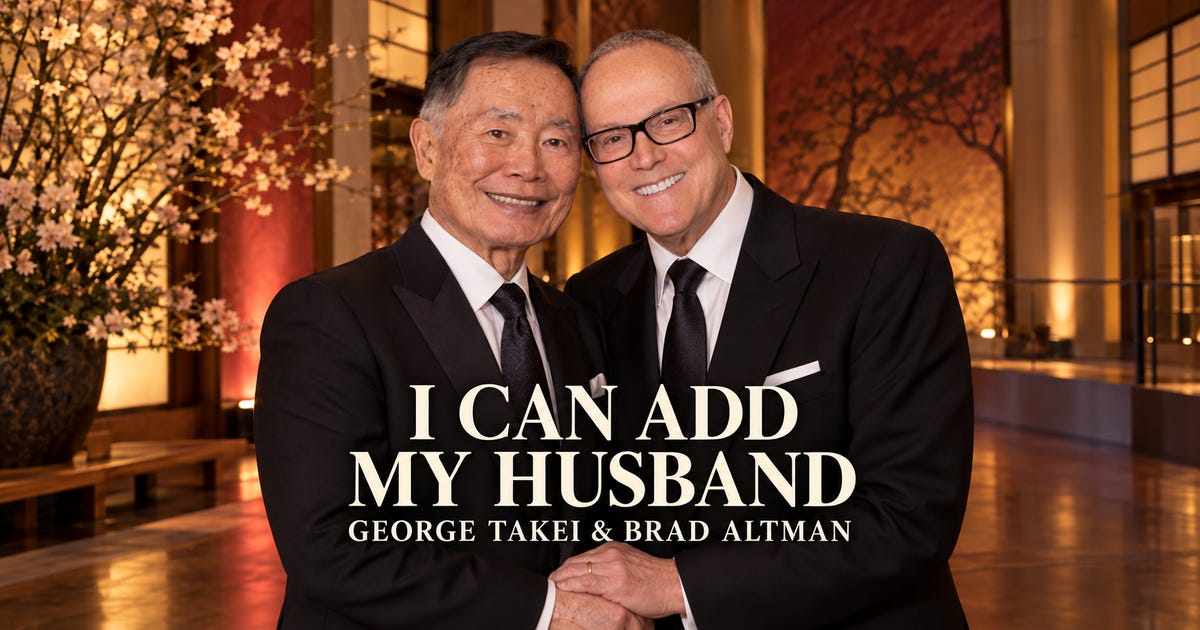
On September 14, 2008, George Takei and Brad Altman stood before two hundred people inside the Democracy Forum of the Japanese American National Museum in Los Angeles. Traditional Japanese koto music greeted the guests. A bagpiper later led the wedding party across the museum plaza. Walter Koenig, George’s Star Trek castmate, served as best man, while Nichelle Nichols rejected the title “matron of honor” and declared herself the best lady.
It was a joyous and deliberately diverse ceremony, but its deepest meaning rested in something much simpler. After more than two decades together, George and Brad could finally call one another husband.
The place mattered. George had helped establish the Japanese American National Museum because he understood what happens when a country fails to preserve the truth about its own injustice. He had spent part of his childhood behind the barbed wire of American incarceration camps during World War II, imprisoned with his family because of their Japanese ancestry. Now, at seventy-one, he was marrying the man he loved inside a building called the Democracy Forum.
Democracy had once taken his family’s freedom. Decades later, through struggle and persistence, it had finally recognized his family.
Yet the wedding was not the beginning of their love story. It was the first time the law had caught up with it.
The Life They Were Not Supposed to Reveal
George and Brad found one another in Los Angeles during the 1980s, a perilous period in which to begin a gay relationship. AIDS was devastating the community while much of the nation responded with indifference, hostility, or moral condemnation. Gay men watched friends disappear, attended funerals in staggering numbers, and learned that grief itself could expose them. In 1986, the United States Supreme Court’s decision in Bowers v. Hardwick allowed states to continue criminalizing private intimacy between consenting adults of the same sex. Love could exist, but the law offered it neither dignity nor protection.
Hollywood imposed another kind of law. Actors did not need to be formally told what coming out could cost them. The absence of openly gay leading men, the fear of being reduced to stereotypes, and the power of studios and casting directors delivered the message clearly enough. A career could vanish because of one truthful sentence.
George already understood how identity could be turned into a liability. He had grown up knowing that his face alone had once been enough for his government to classify his family as dangerous. Later, as an actor, he entered an industry that routinely reduced Asian men to caricatures. His role as Hikaru Sulu on Star Trek broke through that narrow representation, allowing an Asian American man to appear intelligent, capable, composed, and fully part of the future. George knew how much that visibility mattered, but he also knew how fragile his place in the industry could be.
He had spent years challenging racial injustice while remaining silent about the injustice closest to his own private life. This was not hypocrisy. It was survival, shaped by the knowledge that American progress rarely protects people before they take the risk of demanding protection.
Then, amid the fear and loss of the 1980s, George discovered the Los Angeles Frontrunners, a running club where LGBTQ+ people could meet without pretending not to recognize one another. There he noticed Brad Altman, a financial journalist, theater lover, and accomplished runner. George later remembered that Brad was not only the best runner in the club but also exceptionally handsome.
George found a practical reason to approach him. Brad had already completed marathons, so George asked him for help training for his first. They began running together around Silver Lake Reservoir. They discovered a shared love of theater and started attending plays. The training became companionship, the companionship became intimacy, and, as George recalled with characteristic discretion and humor, “things happen.”
George finished the marathon. Brad stayed for the life that followed.
A Marriage Without the Name
Their relationship settled into the ordinary work of loving another person. Brad eventually moved from financial journalism into helping George with publicity, scheduling, business affairs, and the countless details that allowed George to remain the public visionary. George supplied the expansive ideas. Brad made sure the plans became real.
That division of labor could sound merely professional to outsiders, which was sometimes precisely the point. Brad could be introduced as George’s manager, business partner, companion, or friend. Each term contained part of the truth while protecting them from the consequences of saying all of it.
Their private world, however, needed no explanation. They shared a home, supported cultural and charitable institutions together, and placed both their names on donor walls and theater seats. Friends knew. Many relatives knew. Their life was not false, but public language forced it into fragments.
The deepest measure of their commitment came when George’s mother, Fumiko, developed Alzheimer’s disease and could no longer care for herself. George asked whether she could move into their home. Brad answered without hesitation. For the final four years of her life, he helped care for her with what George described as the devotion and affection of a son.
This was love long before a ceremony gave it a socially acceptable picture. It was medication, disrupted sleep, confusion, repetition, worry, and the quiet labor of caring for someone who was slowly losing her connection to the world. Brad was not protected by the legal standing of a son-in-law because the law would not allow him to become one. He performed the responsibility anyway.
When George finally spoke publicly about their relationship in 2005, he did not describe a sudden revelation. He described a life that had been visible to those permitted to see it and hidden from those who held the power to punish it.
“Brad’s my partner, we’ve been together for 18 years. So, I’ve been ‘open,’ but I have not talked to the press.”
The distinction is crucial. George had not spent eighteen years denying Brad within the life they shared. He had spent eighteen years controlling who was allowed to know. That is one of the quiet cruelties of the closet: it does not only ask a person to conceal himself. It asks a couple to divide the world into safe people and dangerous people, safe rooms and dangerous rooms, truths that may be spoken and truths that must be translated into something less revealing.
Brad endured that division beside him. He was the person sharing George’s home, caring for George’s mother, managing the demands of George’s career, and building a common life. Yet before the wider public, the central relationship in both their lives remained incomplete by design.
The Corridor Widens
George’s decision to come out publicly did not begin with a publicity strategy. It began with anger.
In 2005, the California Legislature passed AB 849, the first bill approved by a state legislature that would have opened civil marriage to same-sex couples without a court order. Governor Arnold Schwarzenegger vetoed it. George had watched the state come close enough to equality to put it on the governor’s desk, only to see one signature deny it.
The veto exposed the contradiction George had been living. He had spoken publicly about democracy, civil rights, racial prejudice, and the incarceration of Japanese Americans. Yet when the government diminished the relationship that had sustained him for eighteen years, he felt constrained from speaking as the person most directly affected.
He joined a protest that moved from the Los Angeles Gay and Lesbian Center onto Hollywood Boulevard. The march connected his private anger with the history of public resistance he had known since the civil rights era. George had once met Dr. Martin Luther King Jr. and had spent decades believing that democracy required active participation. Remaining silent now began to feel more dangerous than speaking.
In October 2005, at sixty-eight years old, he sat down with editor Alexander Cho of the Los Angeles LGBTQ+ magazine Frontiers. The resulting interview, “Passion Play,” placed Brad within George’s public life at last. George compared coming out not to opening a single door, but to walking through a corridor that gradually widened as more doors opened and more light entered.
It was an unusually honest image because it rejected the idea that one declaration instantly erases a lifetime of fear. George had been walking toward that interview for decades. Brad had been walking beside him.
The response included hate letters, religious denunciations, and vulgar abuse, but it also brought an overwhelming measure of support. More importantly, George’s public voice was no longer divided. He could speak about racial justice, LGBTQ+ equality, American democracy, and the man he loved as parts of the same moral conviction.
The relationship did not become real in 2005. It became publicly undeniable.
The Word They Had Been Denied
On May 15, 2008, the California Supreme Court ruled that excluding same-sex couples from marriage violated the state constitution. George and Brad were having lunch at home when the news arrived. Before George could propose, Brad slipped from his chair, went to the floor, and asked George to marry him. George told him that he had been about to ask the same question.
They obtained a marriage license in West Hollywood on June 17 and married three months later. Their wedding combined the many strands of the lives they had built: George’s Japanese American heritage, Brad’s embrace of Buddhism, their Star Trek family, their LGBTQ+ community, and the democratic struggle that had finally made the ceremony legally possible.
During his vows, Brad recalled the succession of phrases he had used across more than twenty-one years: life partner, significant other, longtime companion, and lover. They were affectionate terms, but they also reflected a society improvising language for relationships the law refused to recognize.
Then Brad addressed George:
“I can add ‘my husband’ to the list of things I call you.”
Those words reveal why marriage equality was never merely a dispute over terminology. The word husband carried recognition, responsibility, kinship, and belonging. It allowed Brad to name the life he and George had already created without qualification or explanation. He was no longer required to choose a lesser word for the person to whom he had given the greater part of his life.
George’s vows answered Brad’s devotion with a promise rooted in memory. He recalled their first runs, their complementary temperaments, the work they had accomplished together, and Brad’s tenderness toward his mother. He promised to return the care Brad had already given him and to cherish him fully as his husband.
For a few hours inside the Democracy Forum, the story seemed to arrive at its natural conclusion. Love had endured secrecy, fear, illness, and the long wait for equality. At last, the couple stood before their community and spoke the word that had once been unavailable to them.
History, however, was not finished testing that word.
Love After the Vote
On November 4, 2008, less than two months after George and Brad married, California voters approved Proposition 8 and eliminated the right of same-sex couples to marry. Existing marriages, including theirs, remained valid, but the door through which they had passed closed behind them.
The timing was bitter. On the same night that Americans elected Barack Obama as the nation’s first Black president, California withdrew a civil right from gay and lesbian couples. George wrote that he felt pride and sorrow at once. His own marriage remained intact, but he understood that equality cannot be considered secure when it depends upon arriving before the deadline.
George and Brad responded by becoming even more visible. They campaigned for marriage equality, spoke publicly about their relationship, and allowed audiences to see not an abstraction called “same-sex marriage,” but two people who had already spent decades loving, arguing, caregiving, laughing, organizing, and growing older together.
In 2009, they became the first married gay couple to compete on The Newlywed Game. They won, earning $10,000 for the Japanese American National Museum. The appearance was playful, but its cultural significance was real. A television format built around conventional marriage had admitted that George and Brad belonged within the word newlywed, even though their relationship was older than many of the people watching.
The 2014 documentary To Be Takei showed their marriage in its less ceremonial form. Brad could be exacting, private, and impatient with George’s willingness to discuss their home life. George could be expansive, mischievous, and less attentive to schedules. Their differences did not undermine the love story. They made it credible. Endurance is not the absence of irritation. It is the decision that another person’s difficult edges belong within the life you still choose.
In 2015, marriage equality became the law throughout the United States. That same year, George and Brad attended a White House state dinner hosted by President and Michelle Obama. George later reflected on the improbability of the scene: the child once confined in an American prison camp, standing inside the White House during the presidency of the nation’s first Black president, with the man he loved seated across from him.
The country had not become perfect. It had become capable of a moment that the child behind barbed wire and the young closeted actor could never have imagined.
What Forty Years Reveals
Public recognition did not transform George and Brad into symbols without private lives. They remained the two men who had first noticed one another at a running club and discovered that their differences fit together.
George has described Brad as organized, disciplined, punctual, and attentive to detail. Brad gives George an artificially early departure time because he knows exactly how long George will actually take. He reads George’s manuscripts, questions his wording, and helps turn ideas into completed work. George, for his part, brings theatricality, humor, energy, and a willingness to leap before every detail has been settled.
Their longevity includes both laughter and anger. That admission may be one of the most persuasive things George has ever said about their marriage. Lasting love is not endless agreement or permanent serenity. It is the freedom to experience the full range of human emotion without treating every disagreement as an exit.
In a 2024 interview, George reduced Brad’s importance to one plain sentence:
“I would not be who I am today without Brad.”
This is not the language of romantic decoration. It is the acknowledgment that love can become part of a person’s architecture. Brad did not merely accompany George’s transformation from closeted actor to outspoken LGBTQ+ advocate. He helped make that transformation survivable. He protected the details of their life while George learned to reveal its truth. He cared for George’s mother, managed the practical demands of George’s public career, edited his writing, challenged him, steadied him, and remained beside him as private affection became public history.
George’s 2025 graphic memoir, It Rhymes with Takei, finally brought the full story of his sexuality, fear, grief, activism, and love for Brad into a permanent published record. It arrived twenty years after the Frontiers interview and presented the closet not as a simple failure of courage, but as a structure created by prejudice and reinforced by the credible threat of loss.
By then, George and Brad no longer had to hide their relationship to preserve George’s career. Their marriage had become central to the legacy he wanted to leave.
Still In Love
On September 14, 2026, George and Brad celebrated their eighteenth wedding anniversary in New York City. By their own count, they had been together for forty years. The marriage that once had to wait for a narrow opening in California law had now lasted long enough to become part of American LGBTQ+ history.
Nine days later, the Japanese American National Museum announced that George and Brad had pledged their estate, valued at more than $21 million, to the institution. The museum’s new core exhibition will include an image of their wedding as part of the story of Japanese Americans who transformed private experience into public action. A new gallery will bear both their names.
There is something profoundly moving about that conclusion, even though their story is not over. The museum where they became husbands will one day preserve the legacy they built together. George’s extensive collection already holds photographs, correspondence, scripts, awards, campaign materials, and objects from a life spent challenging the boundaries America placed around him. Brad’s name now stands beside his not as manager, companion, or carefully unnamed friend, but as husband and equal steward of their shared legacy.
Their relationship began in a world where gay men were expected to disappear from public life, whether through silence, discrimination, disease, or death. George and Brad refused that disappearance. At first, refusal meant building a durable private home. Later, it meant telling the truth publicly. Eventually, it meant marrying in a forum dedicated to democracy and spending the years that followed helping others claim the same freedom.
The great romance of their story is not that love conquered every obstacle at once. It is that they remained together while the world slowly learned to recognize what they had known all along.
George once asked Brad to help him train for a marathon. Forty years later, they are still running the longer course. They have carried one another through secrecy and visibility, caregiving and aging, anger and laughter, private commitment and public history.
For more than twenty years, the world denied them the simplest truthful word for what they were to each other. Then, at last, Brad stood before George and said it.
My husband.
Source and correspondence credit
The first excerpt was spoken by George Takei to Alexander Cho, the editor and interviewer who conducted Takei’s public coming-out interview. “Passion Play” appeared in the October 2005 issue of Frontiers, the Los Angeles LGBTQ+ newsmagazine, and was publicly reported on October 27, 2005. Its intended audience was the magazine’s readership rather than Brad personally. The original feature, including Cho’s byline and Steven Barston’s photography credit, is preserved in the Frontiers archive on George Takei’s official website. George’s related November 2005 public statement, “Equality and Justice for All,” is also available through his official site archive.
The second excerpt was written and spoken by Brad Altman to George Takei as part of Brad’s wedding vows on September 14, 2008, at the Democracy Forum of the Japanese American National Museum in Los Angeles. The complete vows of both men appear in the “George and Brad Wedding” collection published by Hosato Enterprises, Inc. on the official George Takei website. The page does not identify a separate editor. It is the couple’s own authorized online record of the ceremony, not a transcription from an independent letter collection.
The third excerpt was spoken by George Takei about Brad Takei in an interview reported by Eric Andersson and published by People on April 16, 2024. It was addressed to the interviewer and reading public rather than written privately to Brad. Readers can view the original authorized feature, “George Takei Says the Secret to His Happy Marriage Is ‘Sharing’ These Two Emotions with Husband Brad,” through People. No separate collection editor is credited; People, published by Dotdash Meredith, is the original publisher and archive for the interview.
No authenticated collection of private love letters between George and Brad has been released publicly. For that reason, this feature does not present public interviews or wedding vows as undiscovered private correspondence. It treats them as modern love letters: deliberate words through which the couple named, defended, and preserved their relationship before the public.
The principal authorized book source is It Rhymes with Takei by George Takei, adapted with Steven Scott and Justin Eisinger, illustrated by Harmony Becker, colored by José Villarrubia, and edited by Leigh Walton, with Chris Staros credited as editor-in-chief. It was published by Top Shelf Productions, an imprint of IDW Publishing, on June 10, 2025. ISBN: 978-1-60309-574-7. The memoir is the authorized published account of George’s life in the closet, his relationship with Brad, his decision to come out, and their pursuit of the right to marry.
George’s archival papers are held by the Japanese American National Museum. The George Takei Collection, donated in 2017, contains more than 175 linear feet of photographs, correspondence, scripts, awards, campaign materials, and other records. The museum’s September 23, 2026 announcement of George and Brad Takei’s promised estate gift also explains how their wedding and LGBTQ+ activism will be represented in the museum’s renewed core exhibition.
Historical legal context can be read in the original records for Bowers v. Hardwick, California Assembly Bill 849, and the California Supreme Court’s 2008 decision in In re Marriage Cases.
Words can still move the world. Read mine → https://substack.com/@jhirwin
The Still in Love Promise
Every story honors love. Every journey is told with honesty and heart. Every page celebrates the enduring power of love.